The Impact of Anti-RoboCall (STIR/SHAKEN) on Enterprise Businesses and Their Call Centers
STIR/SHAKEN is going to quite literally “shake” up the telco and call center industries. From medical facilities leveraging call centers for life impacting health appointments and billing purposes to banks that outsource customer service to call centers, STIR/SHAKEN impacts a broad spectrum of industries and enterprises.

STIR/SHAKEN gives you the opportunity to improve the successful answer ratio of your outbound calls. It also presents a mechanism to significantly reduce the loss of productivity owing to nuisance calls, inbound to your enterprise.
If your business uses a call center to connect with consumers — on any front — you should care about the impact Anti-RoboCall/STIR/SHAKEN has on your call center client and your relationship with your service provider. There now exists a danger that outbound calls from enterprise will be dropped from September as a result of the Robocall Mitigation Plans mandated by via the FCC submitted by ALL carriers in June, this year.
This blog will unpack the basics of STIR/SHAKEN, why the framework was implemented, and explore the implications of the FCC’s decision.
What is STIR/SHAKEN and why did the FCC implement it?
In short, STIR/SHAKEN is a framework of standards for certifying the source of every telephone call. STIR/SHAKEN stands for Secure Telephone Identity Revisited (STIR) and Signature-based Handling of Asserted Information using toKENs (SHAKEN) standards.
The FCC instituted the framework because, to be frank, American citizens are tired of having fraudulently spoofed calls. Roughly 46% of Americans say they get at least one spam call PER DAY, with 26% saying they get multiple per week. Consider that these calls still come after people have installed spam blockers. It’s the number 1 complaint by Americans to the FCC, by far. Spoofed numbers exhaust and frustrate citizens, so it only makes sense that Congress via the TRACED ACT (December 2019) and enforced by the FCC would figure out a way to reduce that irritation. As the implementation continues, STIR/SHAKEN will also help Americans gain more confidence in the caller ID information given by telco providers.
In essence, every phone call will be certified, using encryption technology, to authenticate the user actually owns the phone number they are calling from. For call centers, however, it’s a matter of ensuring that service providers handle your calls correctly under the STIR/SHAKEN framework to ensure they don’t get dropped.
How STIR/SHAKEN Impacts Enterprise Businesses and Contact Centers
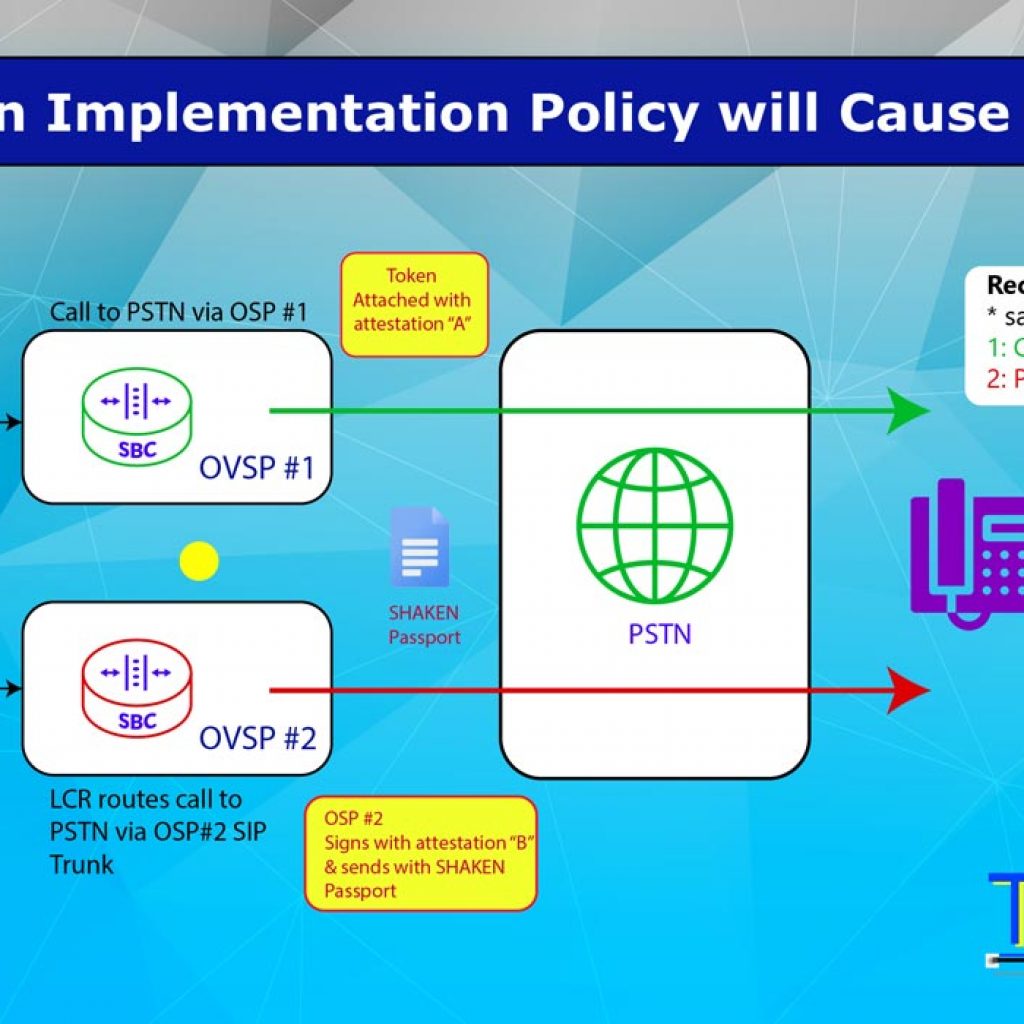
If your enterprise leverages call centers or if you manage a call center, you’ve likely been told by your carrier: “Your calls will be given attestation A as long as they remain on our network until they are terminated.”
If you’re a call center company, you may have customers of varying reputation. If a call center sends out calls using one of its premier client’s DIDs (Direct phone number) allocated from a T1 carrier (such as AT&T on an AT&T SIP Trunk), then AT&T will likely give it attestation A. However, if a call center sends calls with a DID leased from voice service provider ‘A’ from an enterprise SBC on a SIP trunk belonging to voice service provider ‘V’, that can negatively impact the attestation given to the call.
There are a number of questions industry experts are still grappling with:
- What would happen if inadvertently the BPO sends out a client B call with a client A DID and client B abuses this?
- What happens if an enterprise moves off their carrier’s network or uses a Least Cost Routing service, sending Carrier A’s DID over any network?
- How proactive can businesses be in terms of ensuring outbound calls are certified?
What Businesses Can Do Regarding STIR/SHAKEN
The key for any business — be it enterprise or the call center itself — is staying on top of your calls through consistent testing and monitoring and understanding how your carrier is treating them and their attestation level End-to-End. Once attestation level drops to ‘C’, it’s one step (or zero steps) away from being dropped.
Solutions Include
- Active testing to show where the problem is more intense and where we don’t have to worry about it
- Consider obtaining your own SHAKEN certificate and becoming a vetted originator
- Work with Teraquant and your service provider to include Rich Call Data (RCD) with your SHAKEN PASSport
How Teraquant Can Help
Teraquant specializes in testing, troubleshooting, and monitoring of STIR/SHAKEN and providing Big-Data analytics for Robo Call Mitigation (RCM). We have partnered with Transnexus, whom you will know for the STIR/SHAKEN services. We connect their service to customer networks leveraging our SBC expertise.
We are trying to get a discussion going within Enterprise & Call Center Telecom professionals regarding best practices and how to prepare for the upcoming implementation in late September when traffic will start getting blocked. We’ve got a lot of questions left to answer, and we want to hear from you about your concerns or preparations for STIR/SHAKEN. Head over to the Teraquant LinkedIn page to join in on the discussion and see what industry experts are saying.
The next article in this series will talk about Rich Call Data (RCD) and how you can get ahead of these changes and improve your answer rate beyond just certifying your calls.
It’s all about restoring and increasing trust in our public global telephone network.
If you would like to know more about the subjects in this article, please get in touch as below.
For more information, view the OCOM information on:
SIP Monitoring in Real-Time